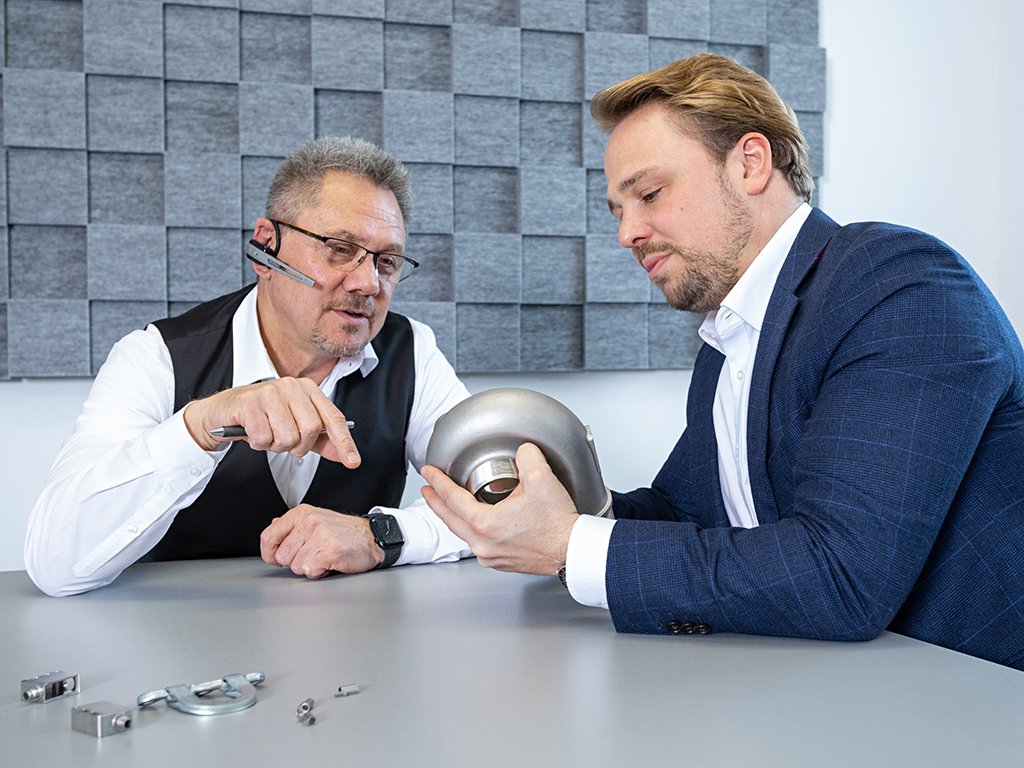
Investment Casting, Die Forging, MIM, or Sintering?
The process best suited for your component is not determined by a single parameter. The geometry, material, load, quantity, and desired delivery condition must all be compatible. A direct comparison can help with the initial assessment.
An initial selection; not a remote diagnosis
The table shows typical suitability characteristics and limitations of the four processes. A specific component may be suitable for multiple processes. Sometimes, even a single requirement can rule out the approach that initially seems most obvious. For the initial technical assessment, Richter Formteile considers the drawing, function, material, requirements, and desired delivery condition as a whole. Only then can a decision be made as to which process should be pursued.
ⓘ Good to know: You don’t need to know the process yet. A drawing or 3D data, along with information on function, preferred material, annual demand, functional dimensions, and delivery condition, are sufficient to get started.
Investment Casting
MIM
Sintering
Drop Forging
A Direct Comparison of Four Methods
The table classifies investment casting, die forging, MIM, and sintering according to the same criteria. The Richter reference values cited use, in some cases, different reference parameters and manufacturing conditions. These differences are therefore explicitly highlighted.
Swipe or scroll to the right to compare →
| Comparison criterion | Investment casting | Die forging | MIM | Sintering |
|---|---|---|---|---|
| Shaping | Cast the wax model in ceramic, melt out the ceramic, and cast the metal | Forming solid metal in contoured dies | Injection-molding metal powder and binder, debinding, and sintering | Pressing and sintering metal powder in a die |
| Often suitable when | delicate contours, openings, or internal geometries are to be cast | the component must withstand forces, impacts, or repeated cyclic loading | small metal parts combine many details or functions | contours can be formed in the direction of pressing, or porosity serves a functional purpose |
| Geometry | High design freedom; consider the gating system, mold filling, and solidification | Material flow, parting line, radii, and demolding determine the basic shape | Complex small components; consider demolding, wall thicknesses, and sintering shrinkage | The pressing direction and ejection determine the features that can be directly formed |
| Component weight | 0.05 to 150 kg | 0.04 to 150 kg | 0.001 to 0.150 kg | 0.001 to 15 kg |
| Materials and Properties | Steel, stainless steel, aluminum, and approved specialty alloys | Steel, stainless steel, aluminum, copper and brass alloys, titanium and nickel-based alloys | Steel, stainless steel, cemented carbide, copper, and other approved MIM materials | Sintered iron and sintered steel, stainless sintered steel, and sintered bronze |
| Mechanical Stress | Evaluate the alloy, casting quality, geometry, and heat treatment collectively | Fiber orientation and material condition can be tailored to the load | Optimize material, density, geometry, and treatment for the specific load case | Include residual porosity and density in the functional and load testing |
| Typical Richter guideline for tolerances | approximately ±0.7% of the nominal dimension | approximately ±0.3 to ±1 mm, depending on nominal dimension, component size, geometry, material, and manufacturing condition | Approximately ±0.5% of the nominal dimension | Approximately ±0.4% of the nominal dimension |
| Surface and functional surfaces | Guideline value: approximately Ra 6.3 µm; condition and measurement point to be determined on a project-by-project basis | Specify forged surfaces and machined functional surfaces separately | Guideline value: approximately Ra 3.2 µm; condition and measurement location to be determined on a project-by-project basis | Guideline value: approximately Ra 3.2 µm; condition and measurement point to be determined on a project-by-project basis |
| Tools and Production Requirements | Consider tools for wax models, mold assembly, and rework collectively | Include die cavities, possible preform stages, material usage, and follow-up work in the calculations | The injection molding tool and process ramp-up must be suited to recurring production needs | The press die and the proportion of directly formable contours determine the effort required, along with |
| delivery condition and follow-up operations | Cutting, grinding, or machining depending on the sprue and functional surface | Deburring, heat treatment, descaling, and machining may be required | Functional dimensions, surfaces, and properties may require further machining or treatment | Calibration, machining, and treatment depending on dimensions, surface finish, density, and function |
| Key Considerations | Mold filling, solidification, shrinkage, and potential warpage | Directly forgeable geometry, tooling requirements, and follow-up work | Component size, wall thicknesses, debinding, and sintering shrinkage | Pressing direction, removal, density, and potential residual porosity |
ⓘ Note on the guide values: Due to the nature of the process, the tolerance specifications use different reference values and do not apply independently of geometry, material, and delivery condition. The surface values also assume an agreed-upon finish and a defined measurement point. Whether a guideline value applies to your component will be verified during the project.
What the standings Alone Can't Determine
Complexity is not a single criterion
A complex contour can lead to different manufacturing processes depending on its size, wall thickness, load, and requirements.
Load-bearing capacity requires a specific load case
The material, geometry, microstructure or density, heat treatment, and testing must be tailored to the actual stress conditions.
Cost-effectiveness doesn’t end with the raw part
Tools, materials, manufacturing, post-processing, testing, logistics, and planned call-offs must all be considered as part of the same assessment.
Richter Formteile evaluates these interrelationships based on your drawings and project data. You’ll receive an initial assessment of which process should be pursued, which alternatives are viable, and which points still need to be clarified before a feasibility study and quotation can be prepared.
What information we need to choose the appropriate procedure
The more complete the information is, the more accurately we can determine the process, materials, follow-up work, and scope of testing. If any details are still missing, we’ll work with you to clarify them.
-
Component Geometry
Drawings or 3D data, external and internal contours, wall thicknesses, cross-sectional features, functional surfaces, and areas with particularly tight tolerances.
-
Function and Load
Operating conditions, load types, force directions, temperature, contact with media, wear, leak tightness, and electrical or magnetic requirements.
-
Material and Condition Upon Delivery
Desired alloy or required properties, heat and surface treatments, scope of assembly, and condition upon delivery.
-
Needs and Project Status
Annual demand, lot sizes, desired production start date, available tooling or existing manufacturing process, as well as the current status of design and approval.
-
Testing and Documentation
Dimensions relevant to function, required material or component tests, sampling, and necessary documentation.

The component's function is the deciding factor
Richter Formteile considers geometry, material, load, requirements, and delivery condition as a whole. When multiple manufacturing methods are possible, we compare the technical implementation and the total effort required to produce the finished component.
Based on this, we select a suitable manufacturing partner and coordinate tooling, prototyping, agreed-upon follow-up work, and the start of series production. As the project progresses, we manage the agreed-upon production and testing steps and coordinate the process through to the specified delivery condition. You will first receive a technical assessment, a list of outstanding test items, and a recommendation for the next logical step in the project.
Which process is right for your component?
Please send us your drawing or, to start, describe the component specifications. You will receive an initial technical assessment, an overview of any outstanding issues, and a recommendation for the next step in the review process.

Your Questions About Choosing a Procedure
Would you like to discuss a geometry, a material, or the planned delivery condition? Your contact person will work with you to determine what information is needed for an initial technical assessment.
Timo Richter
Managing Director
+49 7152 90171-0
t.richter@richterformteile.com
Request a Project
Please send us your drawing and the specific requirements regarding material, annual demand, and delivery condition. We will work with you to assess the suitability of the process and determine how your project can be implemented.