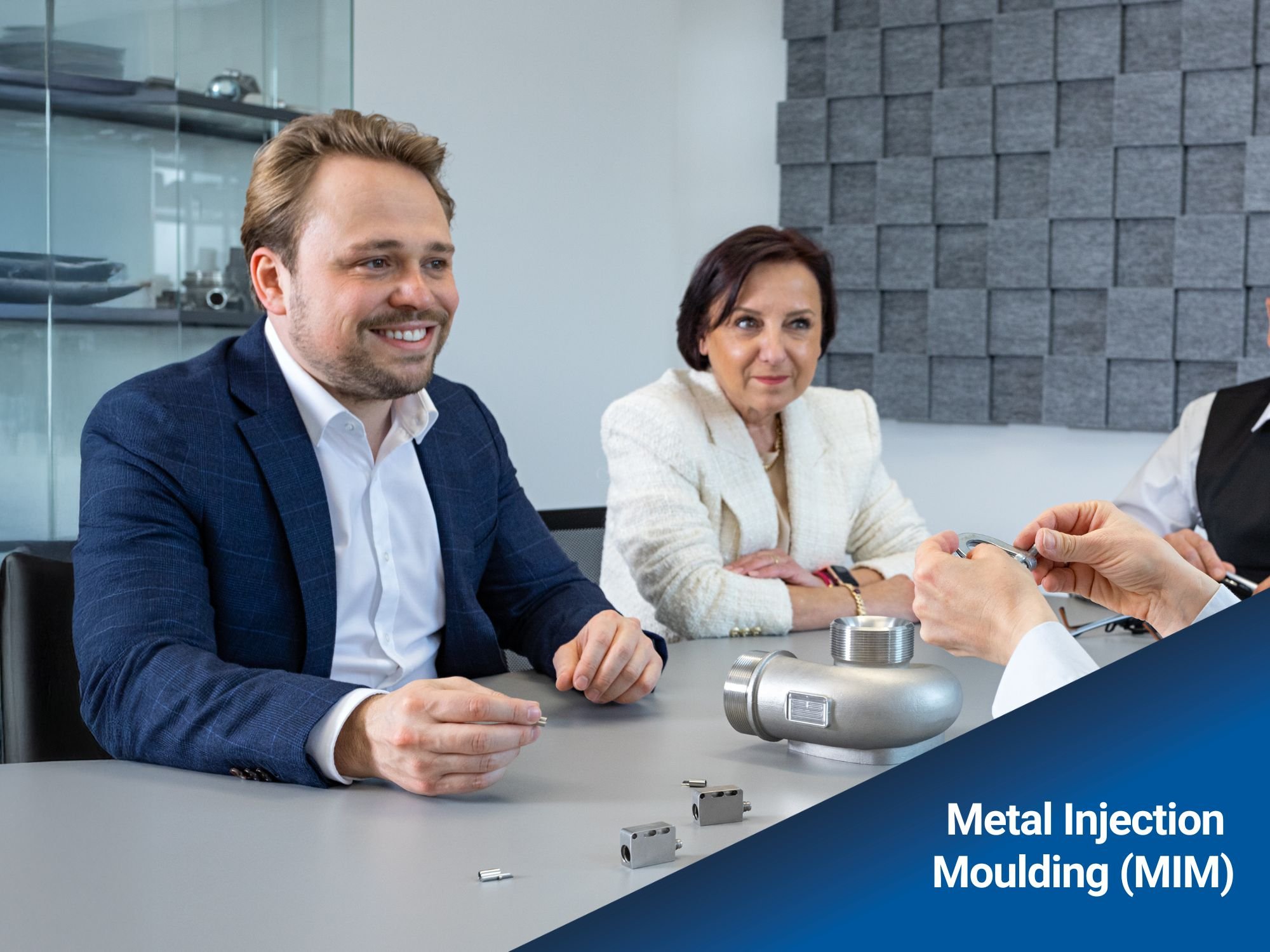
MIM: The technology that unlocks new freedom
Can complex metal parts be made as easily as plastic?
In conversations, I often notice that designers wish for more freedom to bring their ideas to life. Maybe you feel the same. When geometries become increasingly complex and conventional methods reach their limits, Metal Injection Moulding, or MIM, is worth a closer look. For me, it’s one of the most exciting technologies because metal behaves almost like plastic. Even multi-layered, intricate part geometries can be produced directly.
Why is MIM so exciting for modern design?
With MIM, we can manufacture even the smallest precision parts with high geometric complexity economically in series. The metal parts impress with exceptional accuracy, fine detail, and top-quality surfaces. Internal and external threads, holes, undercuts, engravings, or logos can already be formed in the injection mold. This reduces assembly effort and minimizes additional machining.
Our process starts by mixing fine metal powder with a thermoplastic binder to create the feedstock, which is injected into the mold after heating. This produces the “green part,” already carrying all the contours of the final component. Next, we remove the binder in a process called debinding. The resulting “brown part” is then sintered. At high temperature, the metal particles fuse, giving the part its final density, shape, and strength.
A major advantage for you: MIM allows us to use hard-to-machine materials productively and eliminates assembly and joining steps. This saves time and reduces potential errors.
When does MIM make sense—and when not?
Economic efficiency matters, of course. MIM requires a mold, so it becomes particularly worthwhile for medium or larger series. You save time, assembly, and extra machining steps. MIM is perfect when many identical, complex parts are needed—such as in automotive, medical technology, or machinery. For very small quantities or very large parts, other methods are more cost-effective.
Here’s a quick overview of MIM benefits:
- Extensive geometric freedom for custom designs
- Production of multi-layered parts even with the most complex contours
- Dimensional tolerances of ±0.5 % for precise results
- Relative density of 95–98 % for strength and durability
- Lower production costs thanks to efficient processes
- Economical for medium to large series, as tooling costs amortize
- Less post-processing due to precise finished parts
The technology is nearly a century old: ceramic parts were already produced via powder injection molding in the 1920s, and the process became industrially established in the 1980s. Today, MIM is used widely—from automotive to medical devices to electronics.
At Richter Formteile, we support you from drawing to just-in-time delivery. With over 40 years of experience, we ensure your MIM parts are precise, cost-effective, and reliable.
Let’s explore together whether MIM is the optimal solution for your next project. I’ll personally advise you and show you what MIM can do for your parts.
Sounds interesting?
Then simply get in touch with us. We look forward to supporting you with your next project.