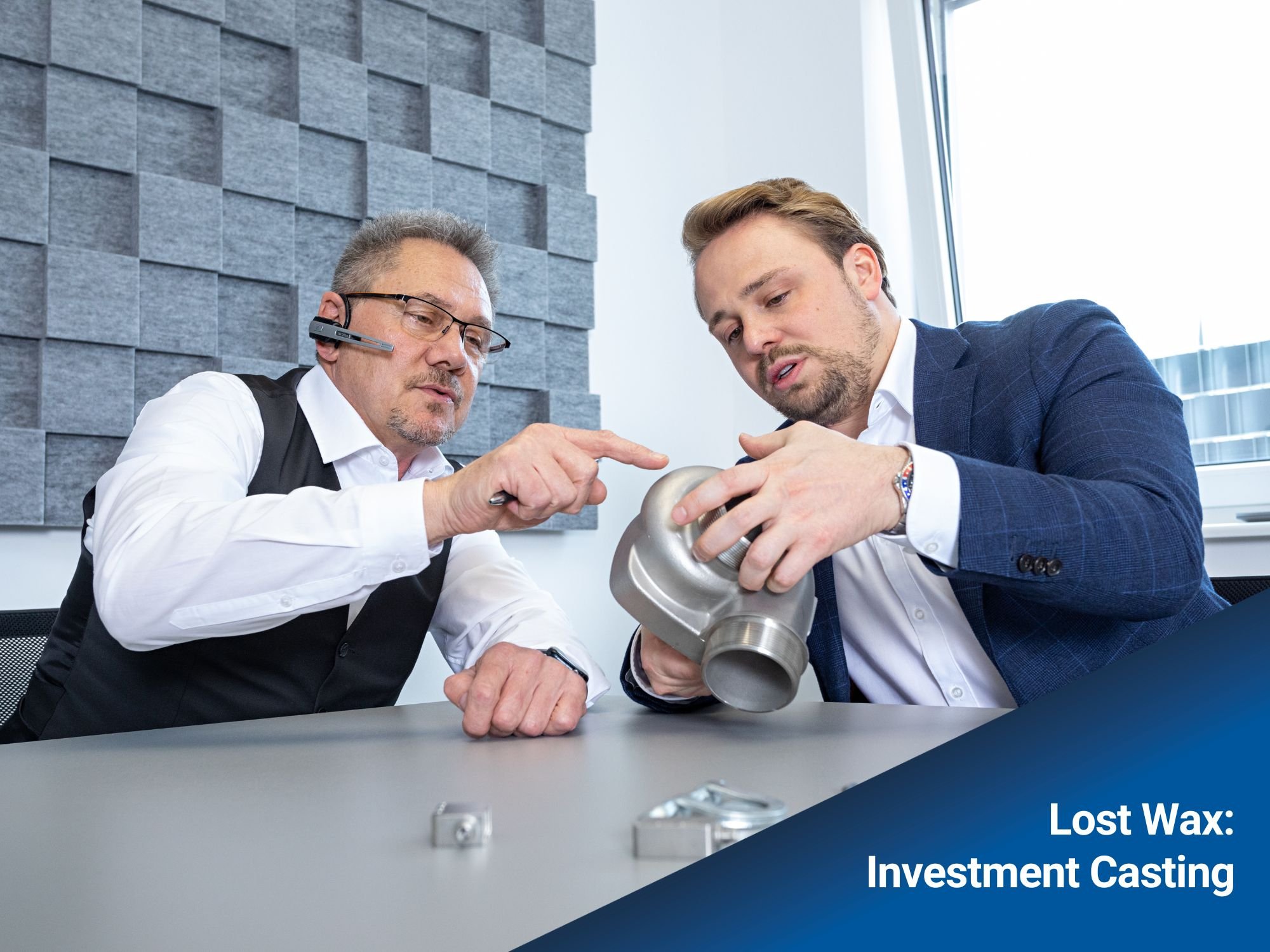
Investment Casting: When Even Complex Shapes Come Naturally
How Are Metal Components Produced Almost Ready from the Mold?
You might know this from practice: components are becoming more delicate, functions move into finer detail, and tolerances get tighter. At the same time, everything should remain cost-effective. This is exactly the point where a closer look at investment casting makes sense.
A Process with History and Future
The process, also known as investment casting or lost wax, is one of the most precise ways to shape metal. The basic idea is ancient—people already worked with lost wax models in the Bronze Age. Today, industrial waxes, ceramic mold materials, and carefully controlled processes are used. This allows the production of highly precise investment castings from ferrous (FE) and non-ferrous (NE) metals, with thin walls, tight tolerances, and surface quality that often requires little or no finishing.
Why Investment Castings Feel “Natural”
Investment casting stands out for its true-to-design geometries. Shapes, transitions and details are formed very close to the final geometry. The investment cast parts leave the mold almost finished. As a result, they behave „naturally“ in use and are functionally consistent.
What Makes Investment Casting So Powerful for Design?
Depending on the application, investment casting opens possibilities that other casting methods quickly limit. Complex geometries can be produced cleanly and reproducibly in a single piece. Key advantages include:
- High design freedom, even for complex contours
- Implementation of intricate geometries in one piece
- Very fine and delicate structures
- High dimensional accuracy with tight tolerances
- First-class surface quality
- Near-net-shape production with reduced machining
- Wide range of materials, including steel, stainless steel, aluminum, and alloys
How Does the Investment Casting Process Work?
The process may seem elaborate at first, but in practice, it follows a clear sequence, with every step focused on precision and repeatability. The wax model is crucial, as it replicates the final geometry exactly and determines the casting quality from the start.
- Wax models are produced using molds or 3D printing.
- Models are assembled into a wax tree to ensure even metal flow.
- The wax tree is repeatedly dipped in ceramic slurry and coated with refractory material.
- The wax is melted out, leaving a precise hollow mold.
- Molten metal fills the ceramic mold, even in thin sections.
- After cooling, the ceramic is removed, castings are separated, and surfaces are cleaned.
- Optional finishing steps include blasting, grinding, heat treatment, or surface finishing.
Which Applications Are Suitable for Investment Casting?
Investment casting excels wherever precision is required. Typical applications include automotive engineering, mechanical engineering, aerospace, medical technology, and jewelry. Thanks to modern processes, the method is economical not only for large series but also for smaller quantities, especially when machining would otherwise remove a lot of material.
Our View on the Right Process
At Richter Formteile, we have been supporting projects involving metal components for over 40 years. We do not consider processes in isolation but in the context of your requirements. This means: I advise you on the suitable process, select the right partner, and guide your project from the drawing to series production with our team, in a way that is technically sound and economically feasible.
Let’s talk about your component. I’ll be happy to advise you whether investment casting is the right approach for your project.
Send us your inquiry now